
 العربية
 Español
 中文
中文 Deutsch
 Français
 Português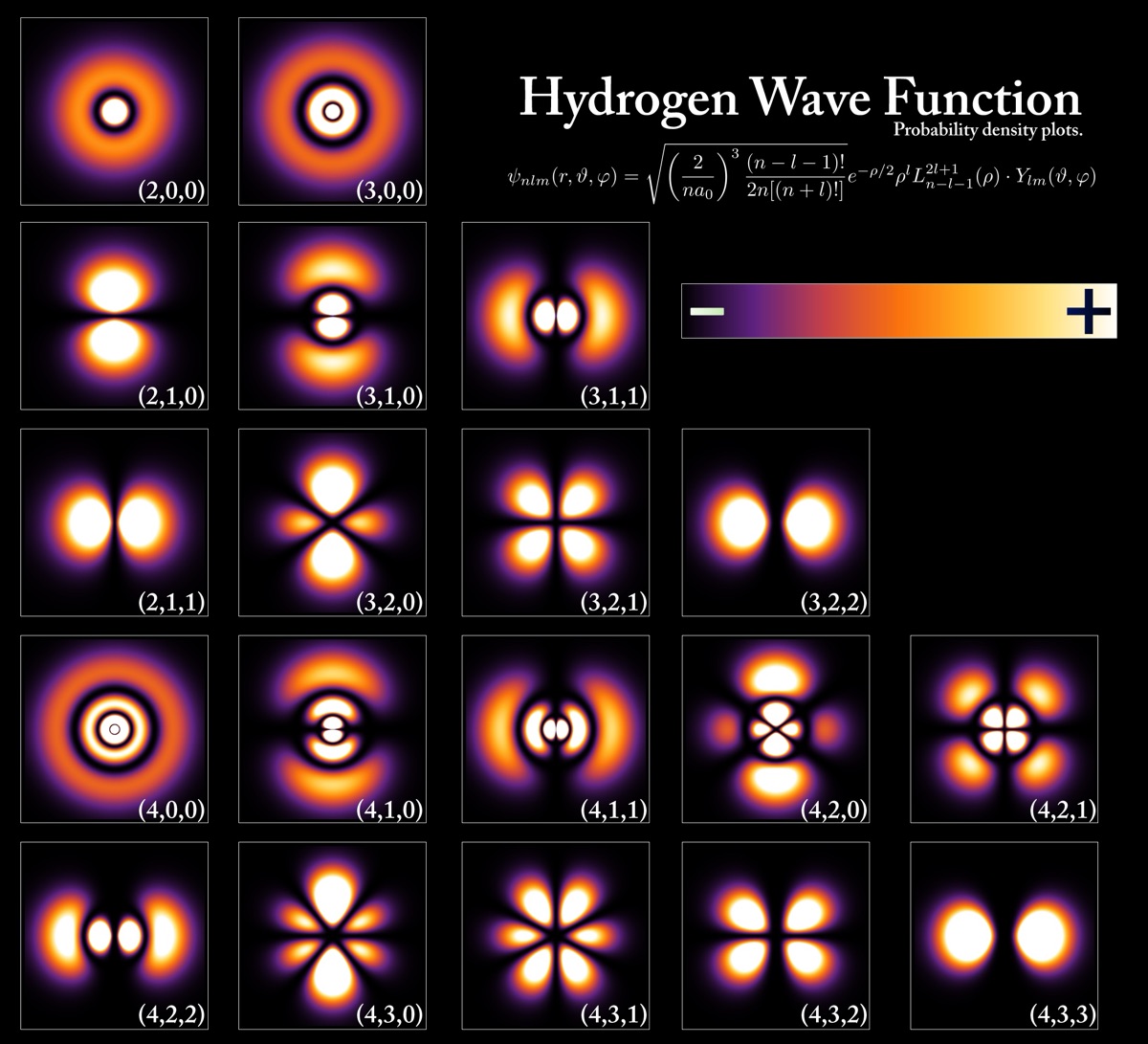
Look again at the device in your hand. The chip running it, the LED lighting its screen, the laser that carried these words down a fibre, the flash memory holding your photos - none of them could have been designed without a single equation a 38-year-old physicist scribbled during a winter holiday in the Alps a hundred years ago. Over roughly two weeks around the turn of 1925 into 1926, Erwin Schrödinger wrote down a wave equation for the atom, published it in a paper he called “Quantisierung als Eigenwertproblem” (Quantization as an Eigenvalue Problem), and gave the world modern quantum mechanics. It remains, a century later, one of the most useful sentences ever written in mathematics.
This is a tribute to the wave that quietly runs the world.
- Who: Erwin Schrödinger (1887–1961), Austrian physicist
- The paper: “Quantisierung als Eigenwertproblem,” four communications in Annalen der Physik; the first received 27 January 1926
- The big idea: treat the electron in an atom as a wave, not a tiny orbiting particle
- The surprise: the atom’s discrete energy levels emerge on their own, as the allowed standing-wave patterns (the eigenvalues) - no hand-added rules needed
- The meaning: Max Born (1926) showed the wave gives the probability of finding the particle in each place
- The honour: the 1933 Nobel Prize in Physics, shared with Paul Dirac, “for the discovery of new productive forms of atomic theory”
- The legacy: the periodic table, all of chemistry, the transistor, the laser, the LED, MRI, flash memory and quantum computing
1. The atom that made no sense
By the early 1920s physics had a beautiful, broken picture of the atom. Niels Bohr’s 1913 model had electrons circling the nucleus like planets, but only in certain special orbits - which is why each element emits only certain sharp colours of light. It worked remarkably well for hydrogen and almost nowhere else, and no one could say why only those orbits were allowed. The rules had to be put in by hand, a patchwork later called the “old quantum theory.” Physicists knew they were missing something deep.
The first breakthrough came in 1925, when the 23-year-old Werner Heisenberg (with Max Born and Pascual Jordan) built matrix mechanics - a powerful but forbiddingly abstract scheme of arrays of numbers, with no picture of what an atom actually looked like. It gave right answers and left almost everyone bewildered. The stage was set for a second, very different revolution.
2. A wild idea, and a holiday in the Alps
The clue came from an unlikely place: a 1924 doctoral thesis by the French aristocrat Louis de Broglie, who made the audacious suggestion that if light waves can behave like particles, then particles like electrons must also behave like waves, with a wavelength of their own. Albert Einstein had read the thesis and praised it, and it was Einstein’s endorsement that put the idea in front of Schrödinger.
Schrödinger seized on it. If the electron is a wave, he reasoned, then there should be an equation - a wave equation - governing how it ripples around the nucleus. Over a roughly two-week holiday at the turn of 1925–26 in the Swiss Alpine village of Arosa, he worked the idea out in one of the most concentrated bursts of creativity in the history of science. He was 38 - practically elderly by the standards of a field then being rewritten by physicists in their twenties. It made no difference. By the time he came down from the mountains he had the equation.
3. The equation - and why quantization stopped being magic
Schrödinger’s original paper posed the problem as finding the allowed energies of a standing wave - an eigenvalue problem, exactly as its title says. In the compact modern form used every day, the time-dependent equation reads:
iℏ ∂ψ/∂t = Ĥψ
Here ψ (“psi”) is the wavefunction - the mathematical wave that stands in for the particle - and Ĥ (the Hamiltonian) encodes its energy. For a system with fixed energy the equation collapses to the eigenvalue form at the heart of the 1926 paper, Ĥψ = Eψ, whose solutions are allowed only for certain special values of the energy E.
And that is the whole magic. When Schrödinger solved his equation for the hydrogen atom, the discrete energy levels Bohr had to assume came tumbling out as those special values - the only energies for which a stable, non-self-cancelling standing wave can fit around the nucleus. It is the same reason a guitar string sounds only certain notes: a wave pinned at its ends can vibrate at some frequencies and not others. Quantization - the “quantum” in quantum mechanics - was no longer a mysterious rule imposed from outside. It was simply what waves do.
Schrödinger gave the world the wave but not, at first, its meaning. That came in July 1926 from Max Born: the wavefunction is not the electron smeared out in space, but a map of probability. The square of its height at each point, |ψ|², gives the chance of finding the particle there. The glowing clouds in the image above are exactly that - the probability densities of the hydrogen atom, drawn straight from Schrödinger’s solutions. Born received the 1954 Nobel Prize for this single, world-changing reinterpretation.
4. Two rival theories, one physics
For a few months in 1926 physics had two brand-new, seemingly unrelated theories of the atom: Heisenberg’s abstract matrices and Schrödinger’s intuitive waves. Which was right? Schrödinger himself settled it that spring, proving that the two formalisms are mathematically equivalent - different languages describing the identical underlying reality. “From the formal mathematical standpoint,” he wrote, “one may even say that the two theories are identical.” Most physicists gratefully adopted his waves, which they could actually picture, and the combined framework became the quantum mechanics we still use.
The honours followed quickly. The 1933 Nobel Prize in Physics went jointly to Erwin Schrödinger and Paul Dirac “for the discovery of new productive forms of atomic theory,” while Heisenberg received the reserved 1932 prize. Three young men, in barely two years, had rebuilt the foundations of physics.
5. Why it explains the periodic table
Solve Schrödinger’s equation for an atom and the solutions are the orbitals - the s, p, d and f shapes drawn on every chemistry classroom wall, each labelled by a set of whole numbers (quantum numbers) that the wave forces to be discrete. Combine those orbitals with Wolfgang Pauli’s 1925 exclusion principle - no two electrons may share the same quantum state - and you can predict exactly how electrons stack up in every element.
The result is the deep explanation of a pattern chemists had found by hand half a century earlier. Dmitri Mendeleev’s 1869 periodic table arranged the elements by their repeating chemical behaviour without anyone knowing the cause. Schrödinger’s equation supplied it: the table’s rows and columns are simply the order in which those wave-patterned orbitals fill up. Chemistry, in a real sense, is applied quantum mechanics.
6. The equation that built the digital age
Here is the part that turns a piece of 1926 physics into the ground beneath modern life. Nearly every signature technology of the last seventy years is a worked solution of Schrödinger’s equation:
| Technology | The quantum idea it rests on |
|---|---|
| Transistors & microchips | The band structure of semiconductors - how electron waves behave in silicon - comes directly from solving the equation in a crystal |
| Lasers & LEDs | Light is emitted when electrons jump between the quantized energy levels the equation predicts |
| Flash memory & tunnelling devices | Quantum tunnelling - a wave leaking through a barrier it ‘shouldn’t’ cross - stores the data in your phone and drives the scanning tunnelling microscope |
| All of chemistry & drug design | Molecular bonds, shapes and reactions are computed by solving the equation for many electrons at once |
| MRI, solar cells & quantum computers | All exploit quantized states and superposition - the wave behaviour Schrödinger first wrote down |
Physicists like to point out that a startling share of the modern economy runs on devices that could not exist without quantum mechanics. Every one of them was engineered by people solving, in one form or another, the equation from that Alpine fortnight.
7. One hundred years on
In June 2024 the United Nations proclaimed 2025 the International Year of Quantum Science and Technology, a resolution co-sponsored by more than 70 countries and launched with a ceremony at UNESCO headquarters in Paris - marking a full century since Heisenberg, Born, Jordan, Schrödinger and Dirac remade physics in 1925–26. It is a rare thing for the world to throw a birthday party for an equation. This one has earned it: in a hundred years of ever more punishing experiments, Schrödinger’s wave mechanics has never once been found wrong.
Schrödinger himself never stopped wrestling with what his waves meant; in 1935 he dreamed up the most famous thought experiment in science - a cat in a box, both alive and dead until observed - precisely to needle his colleagues about how strange the theory had become. That unease is part of the gift. Richard Feynman later said it plainly:
“I think I can safely say that nobody understands quantum mechanics.”
— Richard Feynman
We may not fully understand it. But we have learned to trust it, and to build with it. We remember the inventions - the chip, the laser, the glowing screen. The deeper marvel is the quiet page of mathematics that made every one of them inevitable: a single equation, written on a mountain holiday a century ago, that told us the atom sings like a string - and taught us to play it.
Sources & further reading
- Wikipedia: Schrödinger equation · Erwin Schrödinger · Louis de Broglie & matter waves
- Original paper: E. Schrödinger, “Quantisierung als Eigenwertproblem,” Annalen der Physik (1926)
- Nobel Prize: The Nobel Prize in Physics 1933 (Schrödinger & Dirac) · The Born rule (|ψ|²)
- International Year of Quantum Science and Technology (IYQ 2025) · UNESCO: 100 years of quantum mechanics
- Image: “Hydrogen Wave Function” probability-density plots by Wikimedia Commons user PoorLeno, released into the public domain
Curated by Jerry Cards - jerrycards.com. Our 致敬 (tribute) series celebrates the landmark papers and discoveries that quietly built the modern world. More at jerrycards.com/news.