
 العربية
 Español
 中文
中文 Deutsch
 Français
 Português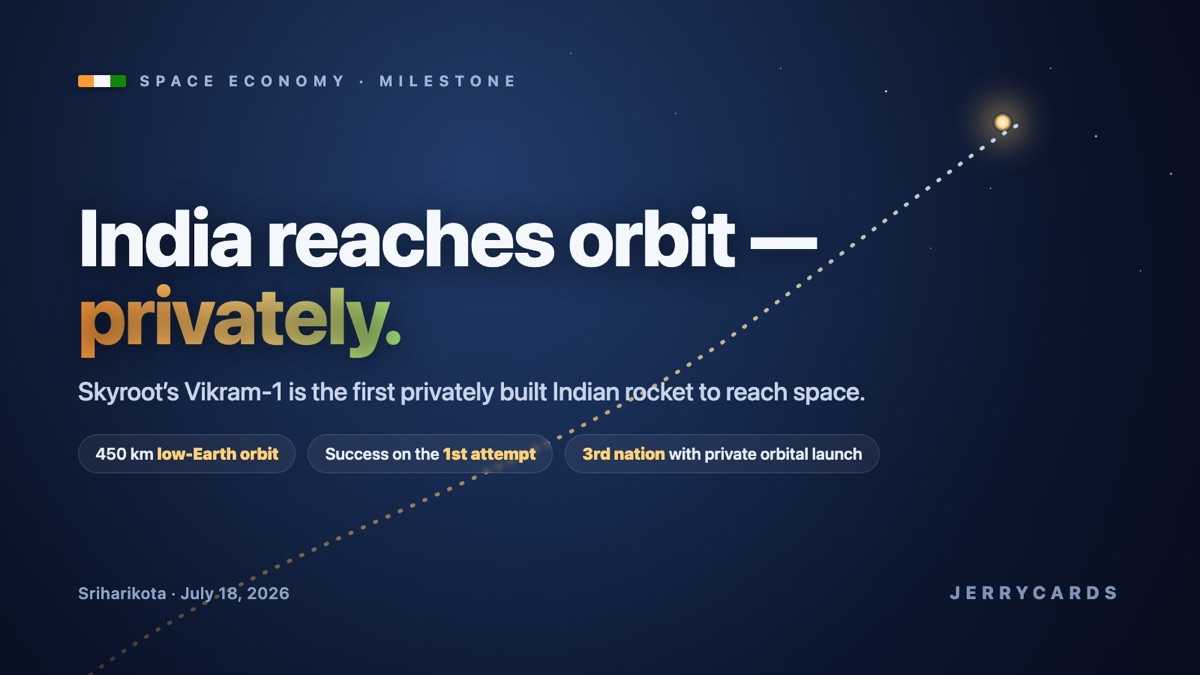
For sixty years, reaching orbit from Indian soil was something only the government could do. On Saturday, July 18, 2026, a startup did it too. At 12:05 PM India Standard Time, a slender four-stage rocket named Vikram-1 - built by the Hyderabad company Skyroot Aerospace - lifted off from the Satish Dhawan Space Centre at Sriharikota, climbed for about fifteen minutes, and slipped its satellites into a roughly 450-kilometre low-Earth orbit. With that single flawless flight, Skyroot became the first private company to launch a rocket to orbit from Indian soil - and did it on its very first attempt, a feat that eluded even SpaceX for three tries.
It is a small rocket carrying a large idea: that the country with the world’s cheapest access to space no longer has to rely on its national agency alone to get there. Here is exactly what happened, how the vehicle works, and why one launch can mark the start of an industry.
- Mission: Vikram-1 “Aagaman” (Hindi for “arrival”), the vehicle’s debut orbital flight
- Date / time: July 18, 2026, 12:05:30 PM IST
- Site: Satish Dhawan Space Centre, Sriharikota, Andhra Pradesh
- Orbit: ~450 km low-Earth orbit at about 60° inclination, reached ~15 minutes after liftoff
- Vehicle: four stages - three solid (KALAM motors) + one liquid upper stage (RAMAN-1 engine); ~22 m tall; ~350 kg payload to LEO
- Payloads: Skyroot’s SCOPE satellite and Grahaa Space’s satellite, plus technology-demonstration payloads
- The milestone: first privately built Indian rocket to reach orbit - and India becomes the 3rd country with a private orbital launch, after the U.S. and China
1. A Textbook First Flight
Debut orbital launches are notoriously unforgiving - roughly half of all first flights of a new rocket fail somewhere between the pad and orbit. Vikram-1 did not. It rose from Sriharikota at 12:05 PM IST, powered through three solid-fuel stages, and lit its liquid upper stage to circularise the orbit, deploying its satellites about fifteen minutes after liftoff at an altitude near 450 kilometres. Skyroot and India’s space regulator confirmed the mission a full success. “The Vikram-1 Aagaman mission is a grand success,” the company declared - a rare clean sheet for a maiden orbital attempt.
2. The Rocket: Four Stages, Two Named for Indian Icons
Vikram-1 is a four-stage small-satellite launcher standing roughly 22 metres tall and rated to carry about 350 kilograms to low-Earth orbit. Three solid-propellant stages do the heavy lifting; a restartable liquid upper stage handles the precise orbital insertion. The hardware names are a deliberate tribute to the pioneers of Indian science.
| Stage | Propulsion | Engine / motor |
|---|---|---|
| Stages 1-3 | Solid | KALAM-series solid motors (cast and tested at Sriharikota) |
| Upper stage | Liquid | RAMAN-1 engine (orbital insertion) |
The rocket itself is named for Vikram Sarabhai, the physicist regarded as the father of the Indian space programme; the solid motors honour former president and aerospace scientist A.P.J. Abdul Kalam, and the liquid engine nods to physicist C.V. Raman. It is, in effect, a roll-call of Indian science flying to orbit.
3. What It Carried
Vikram-1 delivered real, customer, and in-house payloads rather than a symbolic mass simulator. Into low-Earth orbit it placed two satellites - Skyroot’s own SCOPE spacecraft and a satellite from Grahaa Space - and it carried additional technology-demonstration payloads (including hardware from Cosmoserve and DCubed) for in-orbit testing. Flying paying and partner payloads on a maiden mission is a statement of confidence: Skyroot treated its first orbital shot as an operational flight, not merely a test.
4. Why This Is Historic: An Exclusive Club of Three
Plenty of countries can reach orbit. Very few have a private company that can. Building an orbital rocket from scratch as a commercial venture - raising the capital, developing the engines, and surviving the brutal economics of launch - is something only a handful of firms worldwide have pulled off. Vikram-1 makes India the third nation to join that list.
| Country | Year | First private rocket to orbit |
|---|---|---|
| United States | 2008 | SpaceX - Falcon 1 (on its 4th attempt) |
| China | 2019 | iSpace - Hyperbola-1 |
| India | 2026 | Skyroot - Vikram-1 (on its 1st attempt) |
The comparison flatters India in one respect: SpaceX needed four tries to get Falcon 1 to orbit in 2008. Skyroot got there on the first.
A national agency launches on the nation’s schedule and budget. A competitive private launch industry launches on the customer’s schedule - cheaper, faster, and more often. That shift, more than any single rocket, is what turned the U.S. into the dominant launch power of the last decade. India already offers the world some of the lowest-cost orbital delivery through ISRO; adding private launchers is how it scales that edge into a commercial industry.
5. The Startup Behind It
Skyroot Aerospace was founded in 2018 by Pawan Kumar Chandana and Naga Bharath Daka, two engineers who left ISRO to build rockets commercially. In November 2022 the company flew Vikram-S (mission “Prarambh,” or “beginning”) - India’s first privately built rocket, though only a suborbital hop. The years since were spent scaling up to a full orbital vehicle.
Investors took notice. Earlier in 2026, Skyroot crossed a $1.1 billion valuation to become India’s first space “unicorn,” backed by names including Singapore’s sovereign wealth fund GIC and Sherpalo Ventures, with total funding of roughly $160 million. Vikram-1 is the flight that turned that valuation into a track record.
6. The Bigger Picture: A Sector Rebuilt in Six Years
None of this would have been possible a decade ago. In 2020, India opened its space sector to private industry and created IN-SPACe (the Indian National Space Promotion and Authorization Centre) to license and support commercial launches. ISRO and IN-SPACe provided Skyroot with facility access, technical support, and safety oversight for this maiden flight - a public agency deliberately midwifing its own private competitors. Vikram-1 is the first orbital dividend of that reform.
Prime Minister Narendra Modi framed the achievement in generational terms, saying it would “encourage countless youngsters to dream bigger and innovate fearlessly.” It also slots neatly into a global story: private capital is steadily taking over the business of reaching space, from SpaceX in the U.S. to a wave of Chinese launch startups - and now India, whose combination of engineering talent and low costs makes it a natural home for a commercial launch industry.
What to Watch Next
- Cadence. One launch is a milestone; an industry needs many. The test now is how quickly Skyroot can fly again and at what price.
- Customers. Small-satellite operators worldwide want cheap, dedicated rides. A reliable, low-cost Indian launcher could win a real share of that market.
- Company. Skyroot is not alone - other Indian launch startups are close behind, and the sector’s depth will decide whether this is a one-off or the start of something durable.
Sources
- ISRO: First private orbital launch lifts off from Sriharikota
- Space.com: Vikram-1, India’s 1st private orbital rocket, aces its debut launch
- Via Satellite: Skyroot Aerospace makes history for India with first launch success
- Al Jazeera: India achieves milestone with launch of first private-sector orbital rocket
- TechCrunch: India’s first space-tech unicorn emerges as Skyroot gears up for orbital launch
- Spaceflight Now (predecessor context): Chinese private company reaches orbit for the first time (2019)
Curated by Jerry Cards - jerrycards.com. We research the week’s most consequential tech, science, and business news so you don’t have to. More at jerrycards.com/news.