
 العربية
 Español
 中文
中文 Deutsch
 Français
 Português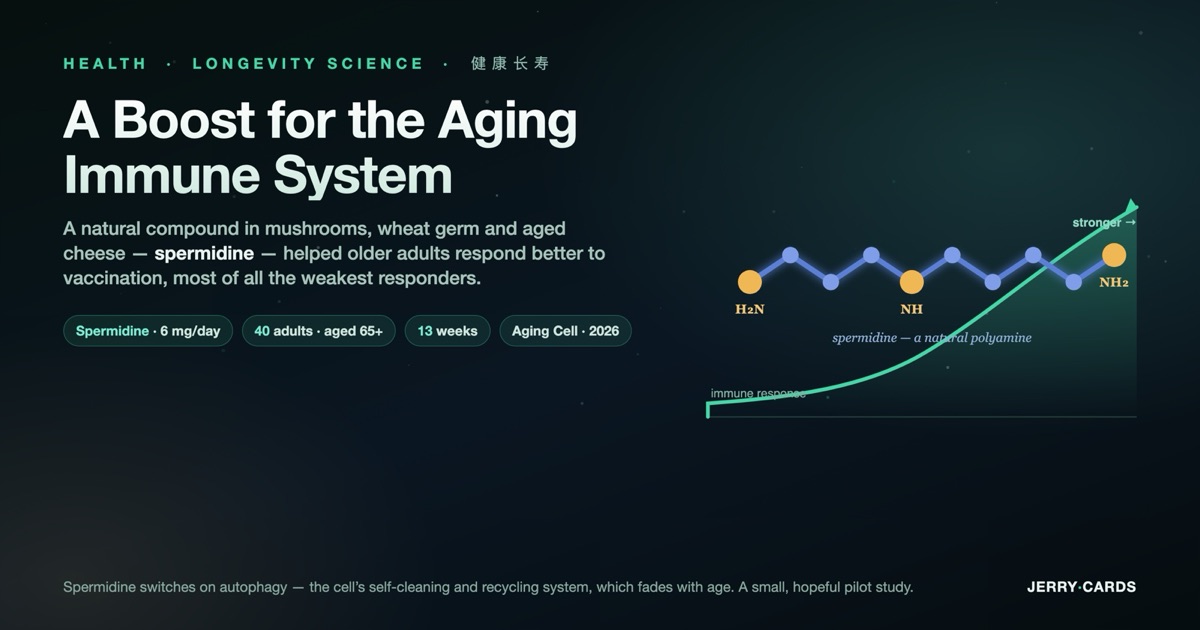
Getting older comes with a quiet, invisible catch: the immune system ages along with the rest of us. Vaccines still protect most people well, but a meaningful minority of older adults never build strong protection - even after repeated doses. A new pilot trial from Berlin and Oxford suggests a surprisingly gentle way to help that aging immune system along, and it begins with a molecule already sitting in ordinary, wholesome food.
The compound is spermidine, a natural polyamine found in wheat germ, mushrooms, aged cheeses and legumes. In a small, carefully run study published in the journal Aging Cell, it helped older adults mount a stronger response to a vaccine - with the biggest benefit landing exactly where it was needed most.
- Who ran it: Max Delbrueck Center for Molecular Medicine (Berlin) and the University of Oxford, with the Oxford Vaccine Group and Cardiff University
- Published: Aging Cell, Vol. 25 (6), 2026 — ‘Spermidine Mitigates Immune Cell Senescence and Boosts Vaccine Responses in Healthy Older Adults — A Pilot Study’
- Participants: 40 healthy adults aged 65 and over
- Intervention: 6 mg of spermidine or a placebo, once daily for 13 weeks, after a third COVID-19 vaccine dose
- Result: higher antibody levels and stronger neutralization of viral variants, with the largest gains in the weakest initial responders
- Safety: safe and well tolerated — no adverse effects linked to the treatment
1. Why the immune system slows with age
Immunologists have a name for the gradual weakening of immune defenses over a lifetime: immunosenescence. As the years pass, the body makes fewer fresh, naive immune cells, the existing ones respond more sluggishly, and a low background hum of inflammation builds up. One practical consequence is that vaccines - which work by teaching the immune system to recognize a threat - can produce a fainter, shorter-lived response in older people than in the young.
Most older adults still respond well. But a real subset do not. In this trial, about one in four participants turned out to be weak responders, generating relatively little protective antibody even after a third vaccine dose. As Oxford’s Dr. Ghada Alsaleh framed the problem: “Many older adults respond well to vaccines. But some do not develop strong protection, even after repeated vaccination.” Helping that group is the whole point.
2. Spermidine, and the cell’s recycling system
Spermidine is not an exotic drug. It is a polyamine - a small molecule your own cells make, your gut microbes produce, and you eat every day. It is especially concentrated in wheat germ, mushrooms, aged cheeses such as parmesan and cheddar, soybeans and legumes.
Its interest to aging science comes from what it does inside cells: spermidine is one of the body’s natural triggers for autophagy (from the Greek for ‘self-eating’), the housekeeping process by which a cell breaks down worn-out or damaged components and recycles the useful materials. Autophagy keeps cells clean and functional - and it tends to fade with age. Reawakening it has become one of the most promising threads in longevity research, which is why spermidine is sometimes described as a gentle ‘fasting mimetic’: it nudges the same renewal machinery that fasting and exercise do.
Old immune cells accumulate damage; autophagy is how a cell tidies itself up; spermidine helps switch autophagy back on. The hypothesis the trial set out to test: restore the cleanup, and you may restore some of the response.
3. What the trial did
The researchers ran a placebo-controlled pilot study in 40 healthy volunteers aged 65 and older. Each participant took either 6 milligrams of spermidine or a matching placebo every day for 13 weeks, starting after their third COVID-19 vaccination - a convenient, well-characterized way to measure how strongly an aging immune system answers a known challenge. The team then tracked antibody levels, how well those antibodies neutralized different variants of the virus, and molecular markers of immune-cell aging.
4. What they found
The direction of every key measure pointed the same, encouraging way.
| Measure | Effect of spermidine vs placebo |
|---|---|
| Antibodies vs SARS-CoV-2 | Higher antibody levels in the spermidine group |
| Variant neutralization | Stronger neutralizing activity against several viral variants |
| Immune-cell aging | Reduced markers of immunosenescence; increased autophagy |
| Who benefited most | The weak responders — the ~1 in 4 who had built little protection on their own |
That last row is the heart of the finding. A treatment that helps the average person a little is useful; a treatment that specifically lifts the people who were left behind is far more interesting. “Our findings suggest that spermidine could help restore aspects of immune function in this group,” Alsaleh said.
Across the 13 weeks, spermidine was safe and well tolerated, with no adverse effects linked to the treatment - unsurprising for a molecule the body already makes and eats, but reassuring to confirm.
5. Why it matters
Vaccines are one of the great bargains in medicine, but they can only protect you as well as your immune system can respond. For the older adults whose defenses have quietly slowed, that is a real gap - one that grows more important every year as populations age. A safe, cheap, food-derived compound that helps close it, even partly, would be a genuinely valuable tool.
The deeper reason for optimism is the mechanism. If restoring autophagy really does rejuvenate aspects of the aging immune system, spermidine may be a first, tangible example of a broader idea longevity researchers have been chasing for years: that gently maintaining the cell’s own renewal systems can keep the whole body working better for longer. A better vaccine response might be just the most measurable sign of a wider benefit.
What we still don’t know
- It is small and early. This was a pilot study of 40 people. As senior author Dr. Katja Simon put it, “larger studies will be needed to determine whether spermidine can consistently improve vaccine responses.”
- A supplement, not a plate of dinner. The trial used a purified 6 mg daily dose. It does not show that eating more mushrooms or cheese reproduces the effect, though those foods are among the richest natural sources of spermidine.
- Other vaccines are untested. The study measured a COVID-19 booster. Whether the same boost applies to influenza or other vaccines “is still to be determined,” the researchers note.
- Not medical advice. Anyone considering a supplement, especially older adults on other medications, should talk with a clinician first.
Sources & further reading
- Original paper: G. Alsaleh, A. K. Simon, et al., ‘Spermidine Mitigates Immune Cell Senescence and Boosts Vaccine Responses in Healthy Older Adults — A Pilot Study’, Aging Cell 25(6), 2026, DOI 10.1111/acel.70545
- Max Delbrueck Center / EurekAlert!: ‘Natural compound may help boost vaccine responses’
- ScienceDaily: ‘This food compound may help vaccines work better in older adults’ · SciTechDaily: ‘Natural Compound Found in Cheese and Mushrooms’
- Background on spermidine & autophagy: Spermidine · Autophagy · Immunosenescence
Curated by Jerry Cards - jerrycards.com. We read the week’s most hopeful science so you don’t have to. More at jerrycards.com/news. This article is journalism, not medical advice.