
 العربية
 Español
 中文
中文 Deutsch
 Français
 Português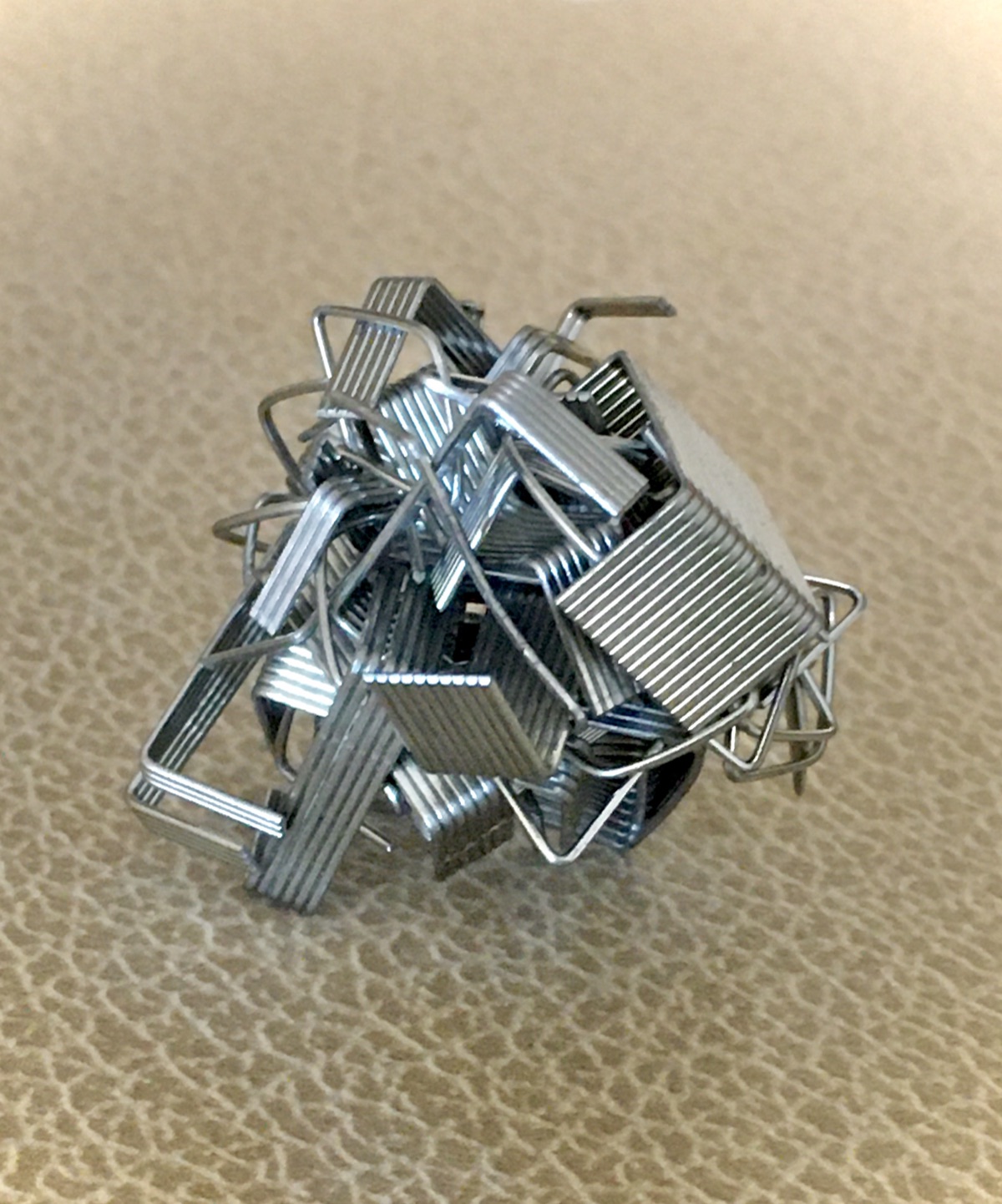
It looks like a jar of ordinary staples. But shake it one way and it stiffens into a solid that can bear a load; shake it another way and it collapses back into a pile of loose grains you can pour out and reuse. Engineers at the University of Colorado Boulder have shown that a material built from thousands of tiny, staple-shaped particles can be switched between rigid and loose on demand - held together by nothing more than the way the pieces tangle. No glue, no welds, no bolts. It is an early but striking step toward structures you could assemble, reconfigure, and take apart again with a vibration - and reuse without throwing anything away.
- What: a material made of tiny staple-shaped particles (two-legged Us) that tangle into a cohesive solid
- The trick: a gentle vibration locks the particles together and strengthens the solid; a stronger vibration untangles it back into loose grains
- Why it is special: the tangled state is both strong and tough at once - a combination that is usually a trade-off
- How: pure geometry - an optimal crown-to-leg angle, with the load carried by as few as 1-3 hidden force chains
- Who: Prof. Francois Barthelat's Laboratory for Advanced Materials & Bioinspiration, CU Boulder (with Youhan Sohn and Saeed Pezeshki)
- Where: Journal of Applied Physics (vol. 139, 145104), April 2026
1. A solid made of nothing but tangles
Most solids hold their shape because their atoms or molecules are chemically bonded together. This one does not. Its building blocks are macroscopic staple-shaped particles - small two-legged pieces shaped like the letter U, or the staples in an office stapler. Poured out loosely, they behave like any granular material: they flow, shift, and pile up like sand or rice.
But when the particles are made to interlock, their legs hook around one another and the whole collection grips into a single cohesive body - a phenomenon researchers call an entangled granular metamaterial. The strength does not come from any adhesive or fastener. It comes entirely from geometry and topology: pieces that are simply too tangled to slip past each other. Prof. Barthelat describes the result as a genuinely strange state of matter - obviously not a liquid, yet not quite a solid either.
2. Two shakes, two states
The headline advance in the new work is control. The team found they could tune how entangled the pile is - and therefore how strong it is - simply by vibrating it, choosing the outcome by how hard they shook.
| Input | What the staples do | Result |
|---|---|---|
| Gentle vibration | settle and hook together, increasing entanglement | a rigid, load-bearing solid |
| Strong vibration | shake loose and untangle | a pile of free-flowing grains |
That reversibility is what makes the material interesting for engineering. The same handful of parts can be locked into a structure, released, and locked again - as many times as you like - without ever changing the parts themselves.
3. Strong and tough at the same time - the hard part
Engineers prize two properties that usually fight each other. Strength is how much load a material can take before it fails; toughness is how much energy it can absorb - how well it resists cracking and keeps going after damage. Materials that are very strong tend to be brittle (a stiff ceramic shatters); materials that are very tough tend to be soft (rubber stretches but cannot hold much load). Getting both at once is a long-standing goal of materials design.
Because the particles are only tangled - not bonded - they can shift, slip, and re-grip under load instead of snapping. That gives the tangled solid a rubber-like ability to absorb energy (toughness) while the interlocking geometry still resists pulling apart (strength). The team's companion experiments and models show the load is not shared evenly: under tension it is carried by a small fraction of the staples, organized into as few as one to three force chains threading through the tangle. Tuning the particle's shape - especially the angle between its crown and legs - sets an optimum that maximizes strength, balancing how tightly the pieces engage against how firmly the tangle holds.
4. Borrowed from nature
Tangling is one of nature's oldest structural tricks. A bird weaves loose, unremarkable twigs into a nest strong enough to hold a family and survive a storm - not by gluing them, but by interlacing them so thoroughly they cannot come apart. Barthelat's lab, named for advanced materials and bioinspiration, is essentially asking how to turn that principle into an engineering material with a dial on it. The group is already testing new particle shapes, including pieces with protruding, burr-like legs meant to grip even more tenaciously.
5. What it could enable
- Recyclable construction. Imagine bridges or buildings assembled from entangled parts with no permanent fasteners. At end of life, a vibration disassembles the structure and every particle is collected and reused in the next project - no demolition, no waste, no downgrade in quality.
- Reconfigurable, shape-shifting structures. Materials that can stiffen where you need support and loosen where you need to reshape - then switch back.
- Swarm robotics. Collections of simple robotic units that entangle into a solid tool or bridge, then flow apart to move - stiffness as a setting, not a permanent property.
- Lightweight engineering materials. Tunable entangled architectures could one day rival the strength-to-weight of solid foams and lattices, with the bonus of being reversible.
Honest caveats
- This is fundamental research: the study establishes the design principle - how particle shape and vibration set strength and entanglement - using lab-scale particles, physical pick-up experiments, and computer models (Monte Carlo and discrete-element simulations). It is not a finished building product.
- The exciting applications - recyclable bridges, swarm robots - are forward-looking. Scaling from a jar of staples to a load-bearing structure is a major engineering journey.
- The result is a proof of concept and a set of design rules, not a single record-breaking number. Its value is the tunability - strength you can switch on and off - as much as the peak strength itself.
Sources
- Y. Sohn, S. Pezeshki & F. Barthelat, “Combined effects of particle geometry and applied vibrations on the mechanics and strength of entangled materials,” Journal of Applied Physics 139, 145104 (2026) - doi.org/10.1063/5.0308921
- S. Pezeshki, Y. Sohn, V. Fouquet & F. Barthelat, “Tunable entanglement and strength in granular metamaterials based on staple-like particles: experiments and discrete element models,” arXiv:2412.05415
- CU Boulder, Paul M. Rady Department of Mechanical Engineering: Staple-like particles reveal a new path to strong materials · EurekAlert release
- Image: “Clump of staples” by Bobthetitn, Wikimedia Commons, licensed CC BY-SA 3.0 - a representative illustration of the staple-shaped particle concept, not the actual experimental particles.
Curated by Jerry Cards - jerrycards.com. We research the week's most consequential tech, science, and business news so you don't have to. More at jerrycards.com/news.