
 العربية
 Español
 中文
中文 Deutsch
 Français
 Português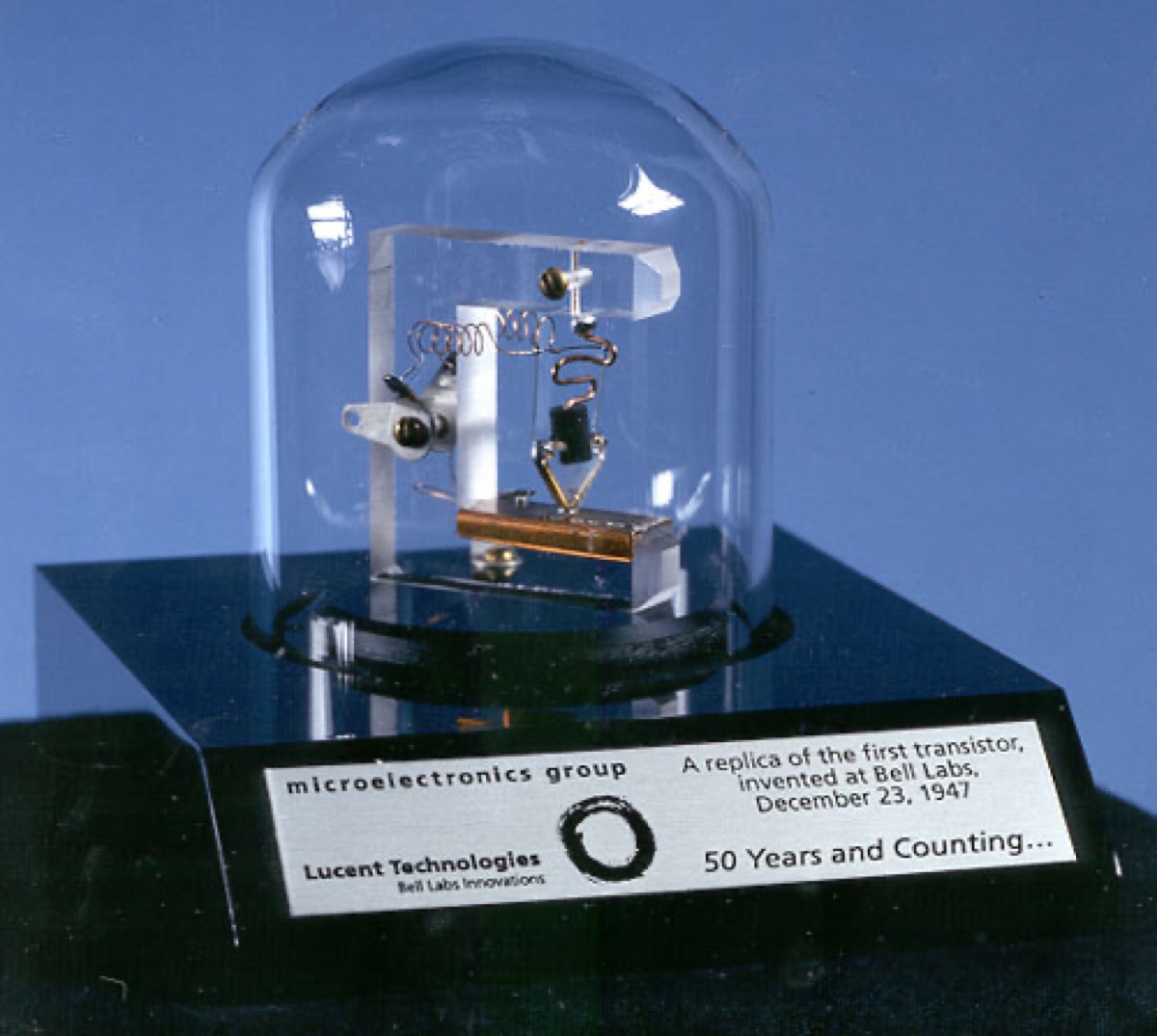
Look at the device you are reading this on. Somewhere inside it, billions of microscopic switches are flicking on and off billions of times a second - and every one of them is a descendant of a single clumsy-looking gadget built by hand on a lab bench three days before Christmas, 1947. On December 16 of that year, two physicists at Bell Telephone Laboratories pressed two gold contacts onto a small crystal of germanium and watched a faint electrical signal come out stronger than it went in. They had built the first transistor - and with it, the foundation of the entire digital age.
This is a tribute to the tiny switch that quietly built the modern world.
- Who: John Bardeen and Walter Brattain, in a group led by William Shockley, at Bell Telephone Laboratories, Murray Hill, New Jersey
- When it first worked: December 16, 1947; demonstrated to Bell Labs management on December 23, 1947
- What it was: the point-contact transistor - two gold contacts on a slab of germanium, able to amplify and switch an electrical signal
- The big idea: a solid piece of semiconductor could do the job of a vacuum tube - but smaller, cooler, tougher and on a fraction of the power
- The name: coined by Bell Labs engineer John R. Pierce in May 1948, from “transconductance” and “varistor”
- The honor: the 1956 Nobel Prize in Physics, shared by Bardeen, Brattain and Shockley
- The legacy: the integrated circuit, the microprocessor, Moore’s Law - and the ~20 billion transistors on a single modern phone chip
1. The tyranny of the glowing glass tube
To see why the transistor mattered, picture the world it replaced. In the 1940s, every radio, telephone exchange and early computer ran on the vacuum tube - a glass bulb with a glowing filament that could amplify a signal or act as a switch. Tubes worked, but they were miserable hardware: bulky, hot, delicate, and thirsty for power. They burned out like light bulbs.
The scale of the problem is captured by ENIAC, the pioneering 1946 electronic computer, which used roughly 18,000 vacuum tubes, filled an entire room, drew enough power to dim the neighborhood, and failed so often that engineers spent much of their time hunting for the next dead tube. If computing was ever going to become small, reliable and cheap, someone had to replace the tube. That was the explicit mission of a solid-state physics group at Bell Labs.
2. December 1947: the signal gets louder
The breakthrough came from a semiconductor - a material that is neither a good conductor nor a good insulator, but something controllable in between. After months of frustrating dead ends (an earlier design by William Shockley simply refused to work), John Bardeen, a soft-spoken theorist, and Walter Brattain, a gifted experimentalist, tried a new approach: two gold contacts, held a hair’s breadth apart by a little plastic wedge, pressed onto the surface of a purified slab of germanium.
On December 16, 1947, it worked. A small voltage on one contact controlled a much larger current flowing through the other - the crystal was amplifying. Brattain’s laboratory notebook recorded the moment with the understatement of a working scientist, noting a voltage gain of about 15. A week later, on December 23, the pair demonstrated the device to Bell Labs management. A solid lump of matter had done what everyone thought needed a vacuum and a glowing wire.
The first transistor was almost comically humble: a triangle of plastic wrapped in gold foil, sliced at the tip to make two contacts a fraction of a millimeter apart, springing down onto a pea-sized piece of germanium. There were no clean-room robots and no silicon - just careful hands, pure crystal, and an idea about how electrons behave at a semiconductor’s surface. That crude object is now one of the most valuable artifacts in the history of technology.
3. Shockley’s answer: the junction transistor
The point-contact transistor was a marvel, but a temperamental one - hard to manufacture and prone to noise. William Shockley, the group’s leader, was also stung that the historic device had been built without him. Over an intense few weeks around New Year 1948 he worked out something better: the bipolar junction transistor, built entirely inside a single sandwich of semiconductor with no fragile point contacts at all (his patent carried a priority date of June 1948).
Shockley’s junction design was rugged, reproducible and manufacturable. Introduced in the early 1950s, it became the true workhorse of the transistor age and dominated the industry for the next three decades. It was also the device that made a home-run consumer product possible: in 1954 the Regency TR-1, the first commercial transistor radio, slipped electronics into a shirt pocket for the first time.
4. What’s in a name - and a very quiet debut
The device needed a name. Bell Labs engineer John R. Pierce supplied it in May 1948, blending “transconductance” (or “transfer”) with the “-istor” of existing components like the varistor and thermistor. Transistor.
On June 30, 1948, Bell Labs unveiled the invention to the press in New York. History, it turned out, was in no hurry to notice. The New York Times gave the announcement a few paragraphs near the bottom of a column about radio programming. Almost no one grasped that the little device on the table would, within a lifetime, rewire civilization.
5. The Nobel - and a record that still stands
The world caught up. In 1956, the Royal Swedish Academy of Sciences awarded the Nobel Prize in Physics jointly to Bardeen, Brattain and Shockley:
“for their researches on semiconductors and their discovery of the transistor effect.”
— The Nobel Prize in Physics 1956
There is a beautiful footnote here. John Bardeen would win the Nobel Prize in Physics a second time, in 1972, for the theory of superconductivity - making him the only person in history to win the physics prize twice. The quiet theorist behind the transistor remains, by that measure, the most decorated physicist who ever lived.
6. From one crystal to twenty billion switches
What turned a laboratory curiosity into the engine of the modern economy was not one invention but a chain of them - and the astonishing fact that transistors get better as they get smaller.
| Milestone | What changed |
|---|---|
| 1947 Point-contact transistor | One transistor, built by hand, replaces the vacuum tube |
| 1958–59 Integrated circuit | Jack Kilby and Robert Noyce put many transistors on one chip |
| 1959–60 The MOSFET | Bell Labs’ Mohamed Atalla and Dawon Kahng invent the transistor type used in nearly every chip today |
| 1965 Moore’s Law | Gordon Moore predicts the transistor count will keep doubling - and it does, for decades |
| Today The modern chip | Apple’s A18 Pro holds ~20 billion transistors on silicon smaller than a fingernail |
Sit with that last line. The switch Bardeen and Brattain could hold between two fingers has shrunk until about twenty billion of them fit on a chip you could balance on your fingertip - each one far faster, more reliable and more efficient than the 1947 original. Every smartphone and laptop, every data center humming behind the internet, every GPU training an AI model, is built from unbroken descendants of that single germanium device. The transistor is, by a wide margin, the most manufactured object in human history.
7. Why it still matters
It is fair to call the transistor the most important invention of the twentieth century. Not because it is glamorous - it is a switch - but because it is the universal building block that everything else is made of. The digital revolution, the personal computer, the mobile phone, the internet, and now the artificial-intelligence boom are all, at bottom, arrangements of transistors turning on and off. Each new wave of technology is a new way of stacking the same 1947 idea.
We tend to celebrate the finished marvels - the phone in the pocket, the model that writes and reasons, the pocket-sized supercomputer that outclasses the room-sized machines of the past. The deeper marvel is the humble component that made all of them inevitable: a sliver of crystal, two gold contacts, and the discovery that a solid piece of matter could control the flow of electrons. Before the transistor, electronics glowed hot behind glass. After it, intelligence could be etched into sand - and we have not stopped since.
Sources & further reading
- Computer History Museum, The Silicon Engine: 1947 - Invention of the Point-Contact Transistor · 1948 - Conception of the Junction Transistor
- The Nobel Prize: The Nobel Prize in Physics 1956 (Bardeen, Brattain, Shockley)
- Wikipedia: History of the transistor · Point-contact transistor · MOSFET
- Britannica: Transistor - Innovation at Bell Labs
- Image: replica of the first (point-contact) transistor, Bell Labs 1947, public domain, via Wikimedia Commons
Curated by Jerry Cards - jerrycards.com. Our 致敬 (tribute) series celebrates the landmark papers and discoveries that quietly built the modern world. More at jerrycards.com/news.